An Overview of Simply Leak Detection's Equipment - How The Job Gets Done
Water leak detection is not a one-tool job. The best results come from matching the equipment to the pipe, the surrounding material, the depth, and the kind of signal a leak is producing. Simply Leak Detection uses a carefully selected mix of acoustic, tracer-gas, pipe-locating, and pressure-testing equipment to find the source while protecting the property above it.
This is an overview of the equipment behind that process - and how each tool helps turn a vague symptom into a precise repair location. Our technicians choose the method that fits the site instead of forcing every leak through the same inspection routine.
Sonic leak detection: listening for the point of escape
When a pressurized water pipe develops a leak, water moving through the opening creates turbulence and vibration. That energy travels through the pipe and into the surrounding soil. Sensitive microphones and acoustic receivers can pick up the change, even when the leak is several feet underground or hidden beneath a slab.
Sonic equipment helps a technician compare the sound of a suspected leak at multiple contact points and narrow the search before the surface is disturbed.
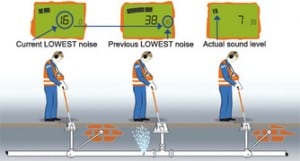
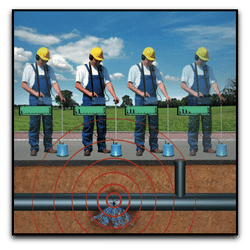
Metrotech HL 5000 + GM80 ground mic
Once an underground leak has been narrowed to an area, a ground microphone helps isolate the loudest point at the surface. The Metrotech HL 5000 and GM80 ground mic system is designed for this fine-tuning step.
The technician moves across the suspected line, compares the sound response, and marks the strongest signal before the repair crew opens the ground.
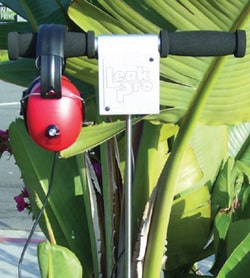
Leak-Pro acoustic systems for slab and underground leaks
Some leaks are especially difficult to hear because they are beneath concrete, flooring, or dense landscaping. Leak-Pro acoustic systems use a highly sensitive, electronically amplified probe to help detect the subtle sound created by escaping water.
This makes the system useful for slab leaks and other locations where access is limited and unnecessary demolition would be expensive.
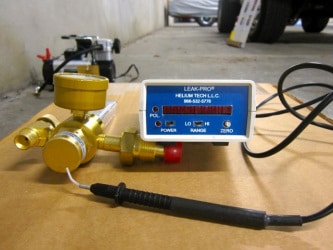
Electronic tracer-gas detection
Acoustic readings are not always enough for a very small leak or a noisy site. In those cases, a safe nitrogen/hydrogen tracer-gas blend can provide a different signal. The blend is introduced into a pressurized, isolated water line; because it can travel through a small crack and rise to the surface, a specialized detector can identify where it is escaping.
Underground water pipe leaks are located primarily through acoustics; we typically also use the safe nitrogen/hydrogen tracer-gas blend as additional confirmation of the leak location.
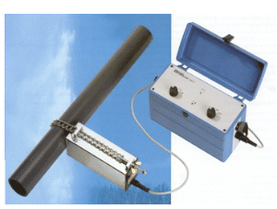
Locating non-metallic water service lines
Plastic and other non-metallic pipes without tracer wire cannot be traced with RF utility locators. Sonic pipe-locating equipment solves that route-mapping problem by sending a controlled mechanical impulse through the line. Underground water pipe leaks are located primarily through acoustics; we typically also use a safe nitrogen/hydrogen tracer-gas blend as additional confirmation of the leak location.
- Controlled impulses reduce the concern of damaging the pipe.
- Fast setup avoids unnecessary water connections or service interruptions.
- Variable intensity helps the system adapt to different pipe materials and ground conditions.

RD7000 for metallic pipes and underground utilities
When the utility or pipe is metallic, the RD7000 uses RF utility-locating technology to provide fast, repeatable locating information. Systems like this help technicians trace conductive pipes and other underground utilities while accounting for different soil types, nearby conductors, and crowded utility corridors.
Knowing where a line runs is valuable before a leak is located and before any digging begins. It helps keep excavation focused and reduces the chance of disturbing a separate utility during repair work.
Portable low-PSI air systems for pressure testing
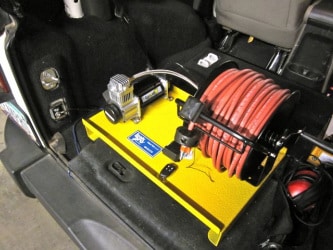
Pressure testing can help determine whether an isolated water system is holding pressure, even when there is no convenient electrical connection or visible water at the surface. A portable 12-volt air system gives the technician a practical way to test in parks, open land, remote areas, and other locations where bringing power to the site is difficult.
Air testing is performed at controlled, low pressure and is selected when it is appropriate for the system. It can help confirm a suspected loss in a private water line before the repair strategy is chosen.
The equipment is only part of the answer
Good equipment makes a precise inspection possible, but the result still depends on knowing which tool to use, where to take readings, and how to interpret the evidence. Acoustic signals, tracer-gas readings, pipe routes, and pressure behavior all tell part of the story.
That combination of technology and experience is what helps Simply Leak Detection find leaks with minimal disruption. The goal is not to dig until something looks suspicious - it is to provide a clear location that gives your plumber or repair contractor the best possible starting point.
Want to see how these tools fit into a real inspection? Read our guides on common water leak detection tools, plastic water pipe leak detection, and pressure testing an isolated water system.
Have a leak you need found?
Simply Leak Detection has located 10,000+ leaks across the Greater Seattle, Tacoma, and Olympia areas since 2010.